
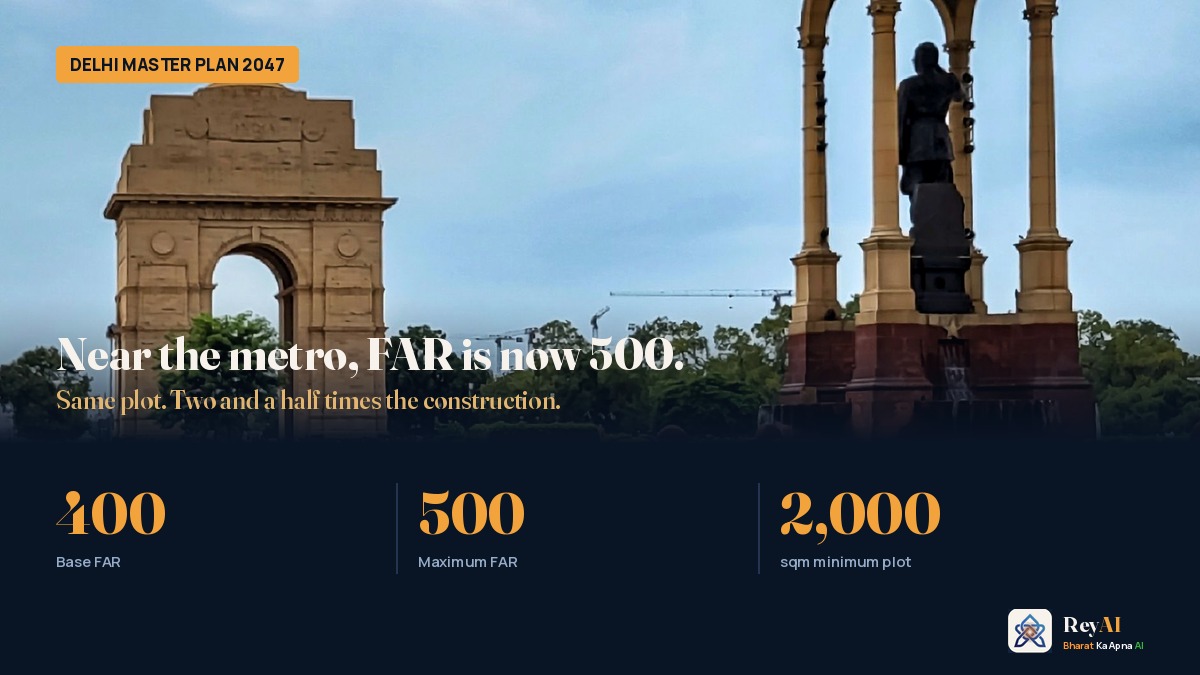
The single largest FAR increase in MPD-2047 sits inside the Transit Oriented Development policy — the metro corridor rules.
Chapter 4.2 of the notified plan sets base FAR at 400 for a metro corridor plot, subject to payment of metro corridor charges, with maximum permissible FAR of 500. FAR beyond 400 requires Additional FAR Charges on a pro-rata basis.
For context, the land pooling FAR under the same plan is 200.
This is one chapter of a larger plan. For what else was decided, see the Delhi Master Plan 2047 overview.
What counts as a metro corridor zone
The gazette defines it as the area within a 500m-wide corridor on either side of the centreline of existing and planned or approved metro corridors, plus a 500m radius node around regional and interstate mass transit stations — RRTS, railway stations, and high speed rail.
The centroid of a transit station is used to delineate the node.
Plot eligibility
A metro corridor plot must cover a minimum of 2,000 sqm. It may fall fully or partly within the zone, but at least 50% of the plot area must be inside it.
It must be accessible from an existing road with a minimum 18m right-of-way. Where no 18m road exists, projects may be considered on a proposed continuous 18m ROW connecting from an existing road of 18m or more.
Where land is surrendered for road widening, the gazette provides FAR benefits for the surrendered portion.
Where it does not apply
Environmentally sensitive areas, Zone 'O' and its buffers, Low Density Areas, Monument Prohibited Areas and heritage buildings, the Civil Lines Bungalow Area, Lutyens' Bungalow Zone and Chanakyapuri, and notified Cantonment areas.
Participation is voluntary
The gazette is explicit: participation in the policy is voluntary. For plots that do participate, the existing land use "shall stand superseded" as per the sanctioned metro corridor project. Owners who don't wish to participate may continue existing activities under normal Master Plan provisions.
Ongoing projects already inside a metro corridor zone are eligible to avail the policy's norms, subject to compliance and payment of applicable charges.
What this means
- For brokers near metro lines: every plot within 500m of a metro corridor now has a defined alternative development route, and the FAR difference between 200 and 500 is substantial.
- For owners of small plots: 2,000 sqm is the floor. Below that, the policy doesn't apply — which makes the "Developer Entity" provision relevant. The gazette allows multiple owners to combine through a legally enforceable agreement to develop a metro corridor plot jointly.
The charges are not yet published. Metro corridor charges and Additional FAR charges are "as notified from time to time." Any calculation of viability is incomplete until those are out.
A corridor launch is usually marketed from a handful of site photographs, which is the exact starting point for photo to video for real estate.
Source: Master Plan for Delhi-2047, Gazette of India Extraordinary, Part II Section 3(ii), No. 4417, notified 20 August 2026 by the Ministry of Housing and Urban Affairs under Section 11-A(2) of the Delhi Development Act, 1957. This article is general information and not legal or investment advice. Several provisions referenced here await detailed Regulations. Verify the planning position of any specific property with the applicable zonal plan and relevant authorities before acting.
Read Next
EnglishDelhi Master Plan 2047 — What Was Actually Approved, and What Changes
The DDA approved Delhi Master Plan 2047 on 12 August 2026 and it was Gazette notified on 20 August. Here's what was actually decided — land pooling, redevelopment, peripheral villages.
24 August 2026All posts