
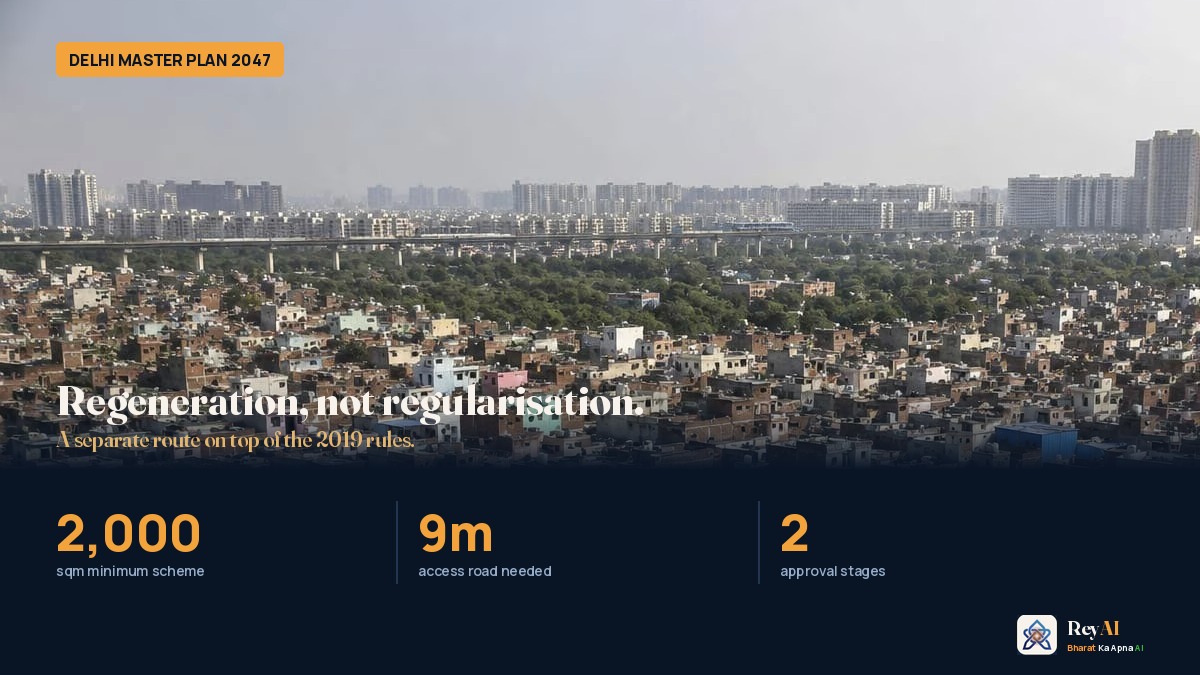
MPD-2047 creates a defined route for regenerating unauthorised colonies, separate from regularisation.
Regularisation continues to be governed by the National Capital Territory of Delhi (Recognition of Property Rights of Residents in Unauthorised Colonies) Regulations, 2019 and its amendments. What the new plan adds is a regeneration scheme framework on top of it.
This is one chapter of a larger plan. For what else was decided, see the Delhi Master Plan 2047 overview.
Who can prepare a scheme
The gazette permits a regeneration scheme to be prepared by a Developer Entity, by RWAs, or by an authorised lead of a group representing part unauthorised colonies or clusters of them — through a legally enforceable agreement.
The minimum
Minimum scheme area is 2,000 sqm. Direct access to the site must be from a minimum 9m right-of-way, subject to meeting parking requirements within the plot.
Two-stage approval
The applicant prepares a Layout and Services Plan in consultation with the concerned authority. Approval comes in two stages: first, approval of the Layout Plan for the regeneration area — for an entire colony, part of one, or a cluster — and second, individual building plan sanctions under the Unified Building Bye-Laws.
What else falls under unplanned areas
The chapter covers unauthorised colonies approved for regularisation, slums and JJ clusters, urban villages including notified Lal Dora and extended Lal Dora, and non-conforming industrial areas and godowns.
It does not apply to environmentally sensitive areas, Zone O, areas regulated by the National Monuments Authority or Archaeological Survey of India, the Civil Lines Bungalow Area, or Lutyens Bungalow Zone.
On slum clusters
The plan adopts the principle of "jahan jhuggi, wahan makan" — in-situ rehabilitation of slum clusters, with the stated aim that residents remain within their own community while receiving safe, dignified housing along with social and physical infrastructure.
What this means
- For a broker: a 2,000 sqm minimum is small. That is achievable by an RWA or a small group of adjacent owners, which makes this practically relevant rather than theoretical.
- If you work in these areas: the two-stage approval route is worth understanding before a client asks. Layout Plan first, then individual building sanctions.
The caveat
The gazette states that regulations for regeneration of unplanned areas "shall be prepared after notification of the Plan." The framework exists. The operating rules do not yet.
The same pattern runs through the plan's housing chapter — a framework and a target, with delivery depending on rules that follow.
Frequently asked questions
Is regularisation the same as regeneration?
No. Regularisation of unauthorised colonies continues under the 2019 Regulations. Regeneration is a separate scheme framework introduced by MPD-2047, which sits on top of it.
What is the minimum area for a regeneration scheme?
2,000 sqm, with direct access from a road of minimum 9m right-of-way.
Who can apply?
A Developer Entity, an RWA, or an authorised lead representing a group of owners in part of a colony or a cluster of colonies, through a legally enforceable agreement.
Can I start a scheme now?
The framework is notified but the detailed regulations are not. The gazette states those will be prepared after notification of the Plan.
Regularised colony stock rarely justifies a shoot, which is the case photo to video for real estate.
Source: Master Plan for Delhi-2047, Gazette of India Extraordinary, Part II Section 3(ii), No. 4417, notified 20 August 2026 by the Ministry of Housing and Urban Affairs under Section 11-A(2) of the Delhi Development Act, 1957. This article is general information and not legal or investment advice. Several provisions referenced here await detailed Regulations. Verify the planning position of any specific property with the applicable zonal plan and relevant authorities before acting.
Read Next
EnglishMPD-2047 Housing Plan — 40 Lakh Additional Homes and Small-Format Housing
MPD-2047 estimates Delhi needs about 40 lakh additional homes by 2047, and promotes small-format housing of 25-60 sqm carpet area.
25 August 2026All posts