
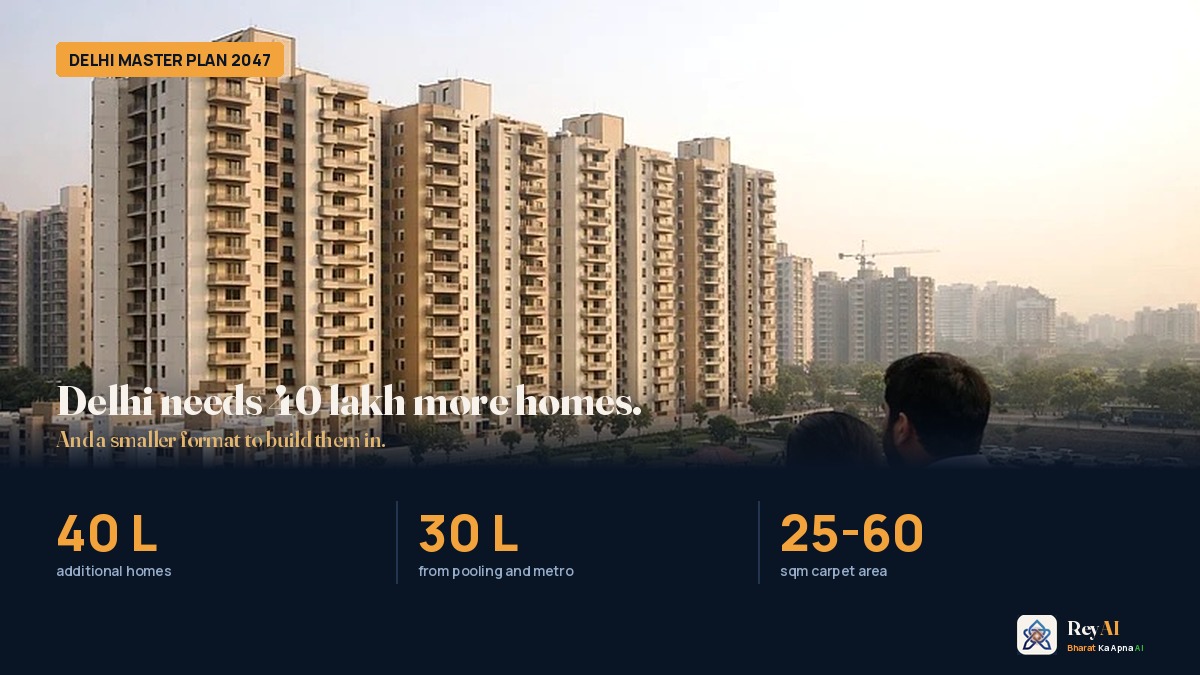
The Master Plan for Delhi-2047 estimates the capital will need approximately 40 lakh additional dwelling units by 2047, based on population growth, changing household sizes and future urban expansion.
The plan projects Delhi serving roughly 3.2 crore citizens by 2047.
This is one chapter of a larger plan. For what else was decided, see the Delhi Master Plan 2047 overview.
Where the new housing comes from
The gazette identifies land pooling areas and metro corridor development zones together as having the potential to provide approximately 30 lakh dwelling units — the bulk of the requirement.
The remainder comes from regeneration of planned and unplanned brownfield areas, development of Low Density Areas, and reconstruction or retrofitting to use increased permissible residential floor area ratio.
Small-format housing
This is the specific provision worth noting. The plan promotes dwelling units of 25 to 60 sqm carpet area, stating this will maximise housing supply given limited land availability.
It also promotes hostels, dormitories and worker housing for students, labour and working men and women, and provides for incentives to the private sector for affordable rental housing.
Group housing is the preferred typology
The gazette states plainly that group housing shall be the preferred typology for residential development, and that the private sector — landowners, developers and other stakeholders — will play a major role, with public agencies acting as facilitator.
That is a notable shift in stated posture for a plan authored by a development authority.
Disincentives for unauthorised construction
To prevent further growth of unauthorised colonies, the gazette suggests local bodies may consider prohibitive property tax, higher electricity charges and higher water charges on unauthorised construction in land pooling areas, Low Density Areas and other vacant land.
What this means
- For a broker: small-format housing at 25 to 60 sqm carpet area is a different product from most NCR inventory. If the incentives follow, the supply mix changes — and the buyer profile with it.
- For a buyer: 40 lakh units is an estimate of need, not a delivery commitment. The gazette describes a framework, not a construction schedule.
Frequently asked questions
How many homes does Delhi need by 2047?
The plan estimates approximately 40 lakh additional dwelling units, based on projected population growth and changing household sizes.
Where will they be built?
Land pooling areas and metro corridor zones together are identified as having potential for approximately 30 lakh units. The rest comes from regeneration and Low Density Area development.
What is small-format housing?
Dwelling units of 25 to 60 sqm carpet area, which the plan promotes to maximise supply given limited land.
Does the plan guarantee this housing will be built?
No. It sets a framework and identifies where supply can come from. Delivery depends on land availability, approvals and market conditions.
Forty lakh homes is a marketing problem before it is a construction one; if you expect to list at volume, the per-reel credit pricing for high-volume brokers.
Source: Master Plan for Delhi-2047, Gazette of India Extraordinary, Part II Section 3(ii), No. 4417, notified 20 August 2026 by the Ministry of Housing and Urban Affairs under Section 11-A(2) of the Delhi Development Act, 1957. This article is general information and not legal or investment advice. Several provisions referenced here await detailed Regulations. Verify the planning position of any specific property with the applicable zonal plan and relevant authorities before acting.
Read Next
EnglishDelhi Land Pooling Policy Under MPD-2047 — FAR, Land Share and Who Qualifies
MPD-2047 sets land pooling FAR at 200, a 60:40 land share between owners and DDA, and a 20-hectare minimum scheme size. Here's the notified detail.
24 August 2026All posts