
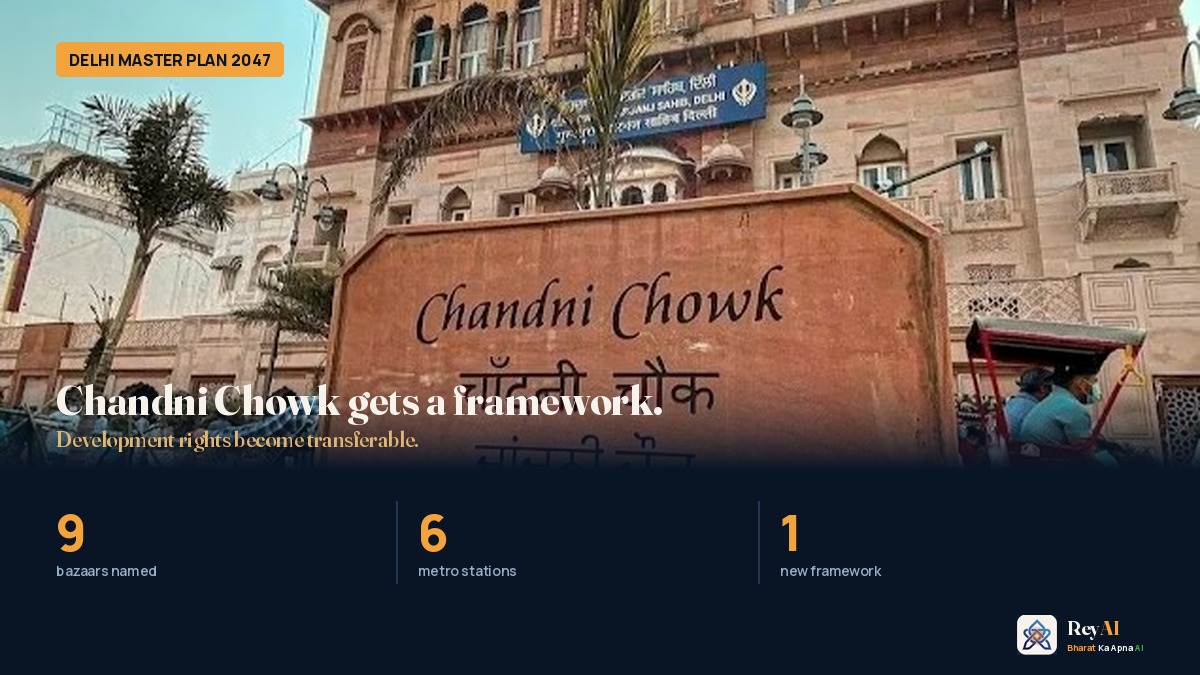
MPD-2047 designates Delhi's historic commercial core as Special Development Areas — the Walled City, Sadar Bazaar, Paharganj and Karol Bagh.
The gazette describes these as compact, low-rise high-density areas with narrow circulation space, mixing residential, retail, wholesale and industrial uses, with significant heritage value. Noxious, polluting and hazardous trades are not permitted.
This is one chapter of a larger plan. For what else was decided, see the Delhi Master Plan 2047 overview.
The Walled City specifically
The plan names the bazaars: Chandni Chowk, Khari Baoli, Chawri Bazar, Dariba Kalan, Kinari Bazar, Nai Sarak, Bhagirath Palace, Sadar Bazar and Ballimaran.
It notes that wholesale activity is gradually shifting toward retail and visitor-oriented business.
Moving development potential off a constrained plot
The most consequential item: the gazette states the plan will introduce a Transferable Development Rights framework to support heritage conservation, road improvements and public infrastructure.
The mechanism allows development potential to be transferred from a constrained site to another location — the standard way of making conservation financially viable for a property owner who cannot build on their own plot.
What else is planned
Adaptive reuse of heritage buildings for cultural centres, museums, boutique hotels, cafes, galleries and craft shops. Replacement of overhead electric cables with underground utility networks. Pedestrianisation of selected streets with wider footpaths and universal accessibility, while retaining emergency access. Aggregated multi-level and shared parking at peripheral locations with shuttle services.
The plan notes the six Metro stations serving the Walled City and calls for strengthened last-mile connectivity through walking, e-rickshaws and non-motorised transport.
Local bodies must prepare schemes
The concerned local body is required to prepare Special Area Redevelopment Schemes, including a Road Network Plan and an Area Improvement Plan, in consultation with residents and stakeholders within a specified timeframe.
Reduced norms are permitted for social infrastructure in these zones, and existing public and semi-public uses — hospitals, dispensaries, colleges, schools, police and fire stations, post offices — are to be retained in their present locations.
What this means
- For owners in the Walled City: the development rights transfer framework is the provision to watch. Whether it becomes useful depends entirely on the receiving-area rules, which are not yet published.
- For commercial property: the shift the plan describes — wholesale toward retail and tourism — is already visible on the ground in Chandni Chowk and Karol Bagh. The plan now supports it, which changes what a commercial property in those areas can become.
A similar unpublished-rules caveat applies to regeneration of planned areas, where the apportionment rules that decide viability are also still to come.
Frequently asked questions
Which areas are Special Development Areas?
The Walled City, Sadar Bazaar, Paharganj and Karol Bagh — Delhi's historic commercial core.
What is Transferable Development Rights?
A mechanism allowing development potential to be transferred from a constrained site to another location. The plan states it will be introduced to support heritage conservation and infrastructure.
Can heritage buildings be reused commercially?
The plan promotes adaptive reuse for cultural centres, museums, boutique hotels, cafes, galleries and craft shops.
When do the schemes start?
The concerned local body is required to prepare Special Area Redevelopment Schemes in consultation with residents and stakeholders within a specified timeframe.
Shahjahanabad properties are hard to film and easy to photograph, which is the argument for turning listing photos into a cinematic property video.
Source: Master Plan for Delhi-2047, Gazette of India Extraordinary, Part II Section 3(ii), No. 4417, notified 20 August 2026 by the Ministry of Housing and Urban Affairs under Section 11-A(2) of the Delhi Development Act, 1957. This article is general information and not legal or investment advice. Several provisions referenced here await detailed Regulations. Verify the planning position of any specific property with the applicable zonal plan and relevant authorities before acting.
Read Next
EnglishMPD-2047's Economic Plan — Narela Education Hub, Logistics Clusters, Business Districts
MPD-2047 proposes a 138-hectare education hub in Narela, modern industrial and logistics clusters, and investment-ready business districts.
28 August 2026All posts