
Beyond land use, MPD-2047 sets out an economic strategy for Delhi to 2047, aligned with the Viksit Bharat 2047 framework.
This is one chapter of a larger plan. For what else was decided, see the Delhi Master Plan 2047 overview.
The five economic initiatives
Investment-ready business and commercial districts — modern commercial areas with quality infrastructure, contemporary office complexes and strong transport links, intended to attract businesses, financial institutions, corporate headquarters, startups and service-sector enterprises.
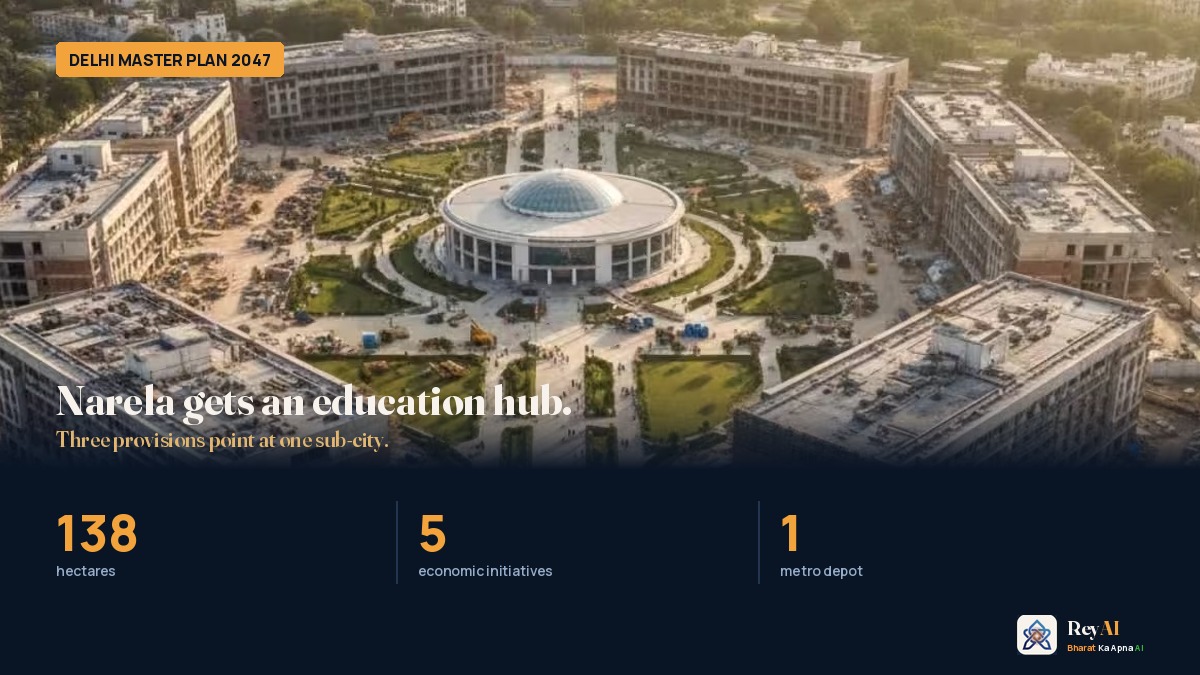
An innovation and research ecosystem — anchored by a proposed 138-hectare education hub in Narela, intended to host universities, research institutions, skill development institutes and startups.
Industrial and logistics centres — modern clusters connected to highways, rail networks and urban extension corridors, including warehousing, distribution centres and integrated freight facilities.
Specialised economic zones — including the High Density Corridor along Urban Extension Road II, promoting compact mixed-use development combining residential, warehousing, logistics and commercial uses.
Mixed-use urban centres integrated with public transport — described in the gazette as one of the most important initiatives in the plan.
The framing shift
The gazette states the plan moves urban planning from a purely regulatory approach toward a development-oriented one, encouraging investment, innovation and employment generation.
That is a notable change in stated posture for a statutory master plan.
The regional dimension
MPD-2047 aligns its spatial development strategy with the National Capital Region Planning Board's regional planning framework — coordinating infrastructure, regional mobility and economic integration across the National Capital Region rather than treating Delhi in isolation.
For brokers working across Gurgaon, Noida and Delhi, that coordination is the part worth tracking.
What this means
- Narela is the location to watch. A 138-hectare education hub, plus the metro depot land use change for the Rithala-Kundli corridor, plus its position within the land pooling zones — that is three separate provisions pointing at the same sub-city.
The caveat
These are proposals within a notified framework. Delivery depends on land assembly, funding and implementation, none of which the plan schedules.
Frequently asked questions
What is planned for Narela?
A proposed 138-hectare education hub intended to host universities, research institutions, skill development institutes and startups, alongside a metro depot land use change for the Rithala-Kundli corridor.
Does the plan change how Delhi approaches development?
The gazette states it moves urban planning from a purely regulatory approach toward a development-oriented one, encouraging investment and employment generation.
How does it relate to the wider National Capital Region?
The plan aligns its spatial development strategy with the National Capital Region Planning Board's regional framework, coordinating infrastructure, mobility and economic integration.
Are these projects funded?
The plan sets a framework. It does not schedule delivery or commit funding.
Narela will be a volume market rather than a premium one, so marketing cost per listing decides the margin — see ReyAI pricing per reel.
Source: Master Plan for Delhi-2047, Gazette of India Extraordinary, Part II Section 3(ii), No. 4417, notified 20 August 2026 by the Ministry of Housing and Urban Affairs under Section 11-A(2) of the Delhi Development Act, 1957. This article is general information and not legal or investment advice. Several provisions referenced here await detailed Regulations. Verify the planning position of any specific property with the applicable zonal plan and relevant authorities before acting.
Read Next
EnglishRegeneration of DDA Flats and Group Housing Under MPD-2047
MPD-2047 allows regeneration of DDA flats, CGHS societies, GPRA and employer housing through property pooling and Road Network Plans.
26 August 2026All posts